
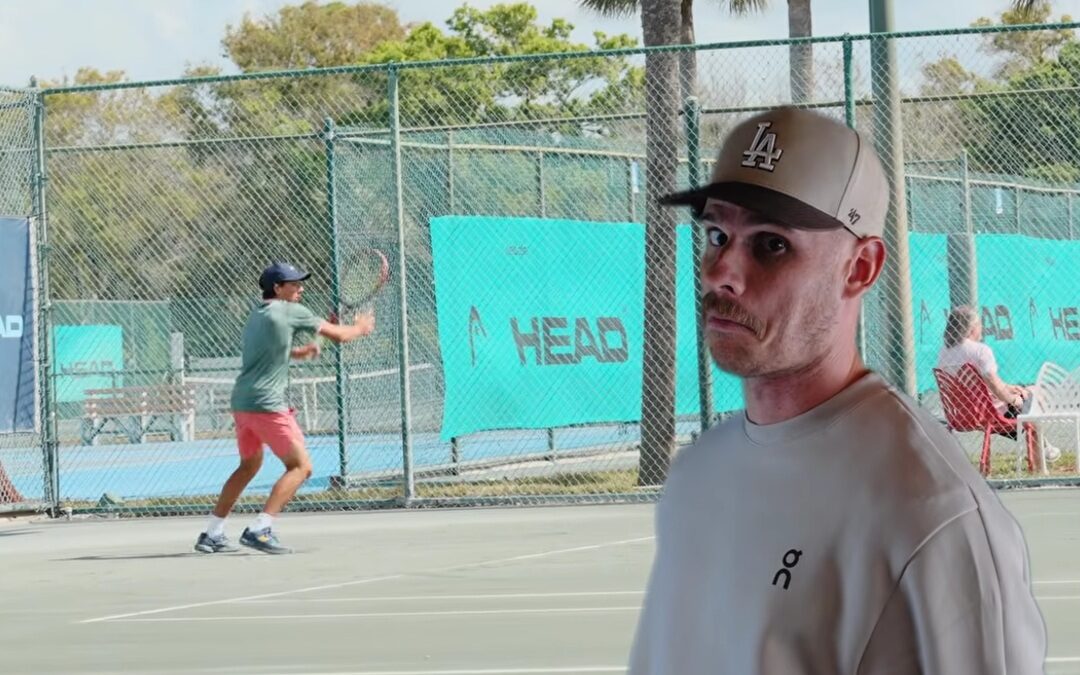
Could Two Forehands Be the Future of Tennis? What Playing Teo Davidov Reveals About the Sport’s Evolution
Tennis is a game built on patterns.
Forehand to backhand. Crosscourt exchanges. Safe targets. Pressure points. Over time, players internalize these patterns so deeply that many decisions become automatic. That’s part of what makes the sport so beautiful at a high level: players are not just reacting to the ball, they are predicting what comes next.
And then along comes Teo Davidov.
At first glance, Teo’s game looks unusual. At second glance, it looks disruptive. By the end of a match against him, it can leave even experienced players asking a bigger question:
Could this actually be part of the future of tennis?
Teo Davidov, still only a teenager, has drawn growing attention for playing with two forehands and no traditional backhand. It is one of the most fascinating and unconventional styles in the sport today. But what makes his game so compelling is not just that it looks different. It’s that it changes the geometry, rhythm, and psychology of a tennis match in ways most players are not used to facing.
This is not about making predictions on exactly how his career will unfold. He is young, still developing, and has a long road ahead. The better conversation is the bigger one: what happens when a player challenges the basic assumptions of tennis technique and succeeds enough to make everyone stop and think?
Who Is Teo Davidov?
Teo Davidov is a rising young tennis player known internationally for his ambidextrous style of play, using two forehands instead of the traditional forehand-backhand combination. He has already attracted attention from tennis fans, coaches, and media because of how effectively he can switch hands, create angles from both wings, and disrupt standard rally patterns.
He is not simply experimenting for novelty. He is building a full competitive game around the concept.
And that concept is powerful.
When most players rally, they naturally try to direct play toward the opponent’s backhand side. Even when a player has a strong backhand, the forehand is still usually the shot that dictates. The backhand often becomes the “safer” place to send the ball in order to gain court position or wait for a shorter reply.
Against Teo, that pattern disappears.
Why Two Forehands Change Everything
One of the strongest takeaways from the match analysis was how deeply Teo’s style disrupts normal tennis instincts.
Most players spend years learning how to:
-
target the backhand side
-
build patterns around forehand dominance
-
anticipate likely shot directions
-
recover toward expected rally positions
Against a player with two forehands, many of those instincts become less reliable.
There is no obvious backhand corner to funnel the rally through.
There is no familiar safe zone.
There is no simple pattern to fall back on.
Instead, the player across the net has to deal with someone who can:
-
create forehand angles from both sides
-
redirect the ball in unexpected ways
-
open the court more frequently
-
make anticipation much harder
That does not just create technical problems. It creates mental ones too.
The player analyzing the match described it as something that “kind of breaks your brain a little bit.” That’s because tennis at a high level depends so much on pattern recognition. If you take away those patterns, the sport feels less predictable and more stressful.
What It’s Like to Play Against Teo Davidov
The match described in the transcript took place in a futures event in Naples, Florida, on slow clay courts with heavy balls and physically demanding rallies. These were already difficult conditions for a player who prefers using pace and getting help from the court.
Normally, in those conditions, one of the standard tactical approaches is simple: work the backhand side, gain position, and then look to dominate with the forehand.
But that was not an option here.
Because Teo has two forehands, the usual clay-court patterns lost much of their effectiveness. Instead of being able to safely build rallies to one side, the opponent had to constantly question where to hit next and how to recover.
That hesitation matters.
In tennis, even a half-second of doubt can lead to:
-
poor shot selection
-
tighter targets
-
rushed swings
-
positional errors
-
unforced mistakes
That is part of what made Teo so difficult to handle. He was not just hitting unusual shots. He was forcing the other player to rethink the court in real time.
The Hidden Pressure of Playing Someone With Two Forehands
One of the smartest points from the transcript is that Teo’s style puts enormous pressure on the opponent’s movement.
Why?
Because forehands generally allow players to create:
-
more shape
-
more topspin
-
more angle
-
more safe aggression
-
more offensive variety
When a player has that ability on both sides, the court begins to feel wider on your side of the net. You are pulled into more uncomfortable positions. You cannot assume the ball will return toward the middle of the court in the usual way.
And because anticipation is more difficult, you feel like you are always a bit late.
That changes the match completely.
Instead of settling into a rhythm, opponents can end up overpressing and aiming too close to the lines, trying to do more than they normally would. That often leads to a higher error count, which was one of the observations in this match as well.
Teo Davidov’s Return and Serve Add Even More Complexity
Another important observation was that many people assume Teo’s return of serve would be a weakness because of the switching involved.
According to the match analysis and conversations around him, that may not be true at all.
In fact, his return is considered one of his best shots.
That makes sense when you think about it. A player who has spent years developing both sides can become extremely adaptable in return situations, especially if the movement and hand-switching are already instinctive.
Teo also serves with both arms, which adds another unusual tactical layer.
That means opponents are not just adjusting to two-forehand rally patterns. They are also dealing with:
-
lefty spin and righty spin on serve
-
different angles from each side
-
a more variable rhythm
-
extra uncertainty before points even begin
It may not yet be the biggest serve in tennis, but it gives opponents one more thing to process — and at the professional level, that matters.
The Athletic Side of Teo’s Game
Another point made in the transcript is that Teo may not look physically imposing at first glance, but he is a far better athlete than many people realize.
He was described as:
-
very strong for his age
-
explosive
-
physically capable
-
trained at a serious level
That matters because a two-forehand system is not just technical. It demands:
-
elite footwork
-
exceptional coordination
-
balance on the move
-
fast recovery steps
-
high-level body control
Without athleticism, the concept would likely fall apart.
With athleticism, it becomes dangerous.
This is a big reason Teo’s game is so intriguing. He is not simply surviving with an unconventional style. He is combining that style with physical tools that allow it to function at a real competitive level.
Are There Potential Drawbacks? Yes.
A fair analysis also has to admit there are legitimate questions.
As Teo rises and faces bigger, older, stronger players more consistently, people will naturally ask:
-
How does this system hold up against 130+ mph serves?
-
What happens on faster hard courts and grass?
-
Does the extra decision-making ever become too much?
-
Can having too many options create indecision?
-
Is there a point where simplicity beats novelty?
These are reasonable questions.
The match analysis suggested that one possible challenge is that Teo may sometimes have too many options. In tennis, too much choice can occasionally create hesitation. When there are multiple ways to play a ball, the danger is that you do not fully commit to any of them.
That does not mean the model cannot work. It simply means that, like any high-level style, it will need refinement, structure, and clear patterns as the level rises.
Could Two Forehands Actually Be the Future of Tennis?
This is the question that makes the whole discussion so interesting.
Sports evolve when someone expands what people think is possible.
Tony Hawk landing the 900 changed skateboarding.
Stephen Curry changed basketball by making deep three-point shooting central to the game.
Novak Djokovic helped redefine modern tennis by showing what true completeness looks like from the baseline.
Progress often begins with disbelief.
At first, something looks strange. Then it looks possible. Then someone younger, more athletic, or more specialized builds on it and pushes it even further.
That is why dismissing Teo’s style just because it is unfamiliar would be shortsighted.
Even if two forehands never become mainstream, Teo Davidov is still contributing something important to tennis:
He is expanding the sport’s vocabulary.
He is forcing players, coaches, and fans to ask:
-
What is truly necessary in a tennis game?
-
What is habit, and what is fundamental?
-
What might future players develop if they start young enough?
-
Could the next great innovator take this concept even further?
Those are fascinating questions.
Innovation in Tennis Usually Starts With Discomfort
People tend to criticize what they do not understand right away.
That happens in every sport.
A new technique, tactic, or training model appears and makes people uncomfortable because it does not fit the existing framework. But discomfort is often the first sign that something significant is happening.
Teo’s game creates that feeling.
Not because it is gimmicky.
Not because it is random.
But because it challenges assumptions that have felt permanent for decades.
And in doing so, it becomes impossible to ignore.
Why Teo Davidov Is Worth Watching
Even if his style remains one-of-one, Teo is worth paying attention to for several reasons:
1. He makes tennis think
Most players play within the existing framework. Teo challenges it.
2. He changes match dynamics
Opponents cannot rely on standard patterns and anticipation.
3. He combines novelty with athleticism
This is not just unusual. It is functional.
4. He forces deeper questions
His game opens real discussion about how tennis might evolve.
5. He is still very young
At this stage, the ceiling is unknown, which makes the story even more compelling.
Final Thoughts: Teo Davidov and the Future of Tennis
It is too early to say exactly where Teo Davidov’s career will go. He is still young, still developing, and still testing how his game scales against stronger and more experienced players.
But one thing already feels certain:
He is making people rethink tennis.
And that alone is meaningful.
Whether two forehands become a larger trend or remain a rare innovation, Teo is proving that the sport still has room for new ideas. He is showing that tradition is not the same as inevitability. He is asking a question that tennis has not fully answered yet.
What if the game does not have to be played the way we always assumed?
At just 15, Teo Davidov is not only building his own future. He may also be giving the sport a glimpse of a different one.
And in tennis, that is more than interesting.
That is worth watching.
